

Description
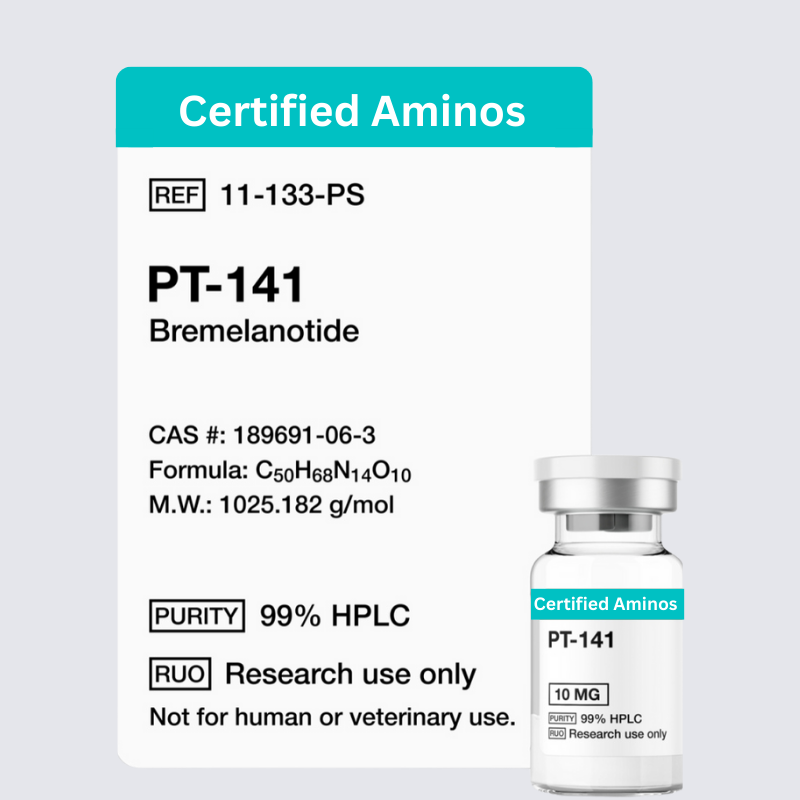
PT-141 10mg – Peptide for Research Use
PT-141, also known by its clinical name Bremelanotide, is a synthetic peptide originally developed as a potential therapy for sexual dysfunction. What sets PT-141 apart is its mechanism of action—it works through the nervous system rather than directly increasing blood flow like many conventional drugs. Researchers have explored its use for both male and female sexual arousal disorders, hemorrhagic shock, and even immune modulation.
What is PT-141?
PT-141 is a modified form of the peptide melanotan II, derived from alpha-melanocyte-stimulating hormone (α-MSH). It primarily activates melanocortin receptors MC-4R and MC-1R, which play key roles in sexual behavior, immune function, and vascular response.
Due to its unique pathway, PT-141 has been widely studied for cases where other treatments, like Viagra, have limited effect—especially when the root cause is neurological rather than circulatory.
Chemical Profile
-
Peptide Sequence: Ac-Nle-Asp-His-D-Phe-Arg-Trp-Lys
-
Molecular Formula: C50H68N14O10
-
Molecular Weight: 1025.18 g/mol
-
CAS Number: 189691-06-3
-
PubChem CID: 9941379
Key Areas of Research
1. Sexual Arousal Disorders
PT-141 is perhaps best known for its role in promoting sexual desire. Clinical studies have shown that PT-141 can increase sexual arousal in both men and women, even in individuals who have not responded to conventional treatments like sildenafil (Viagra).
In one study, nearly a third of men with treatment-resistant erectile dysfunction responded positively to PT-141. For women, trials showed an increase in satisfying sexual experiences and a reduction in sexual distress.
2. Female Sexual Dysfunction (FSD)
Although earlier trials for female hypoactive sexual desire disorder (HSDD) were discontinued, newer studies led to a subcutaneous version of PT-141 known as Rekynda. These trials used improved clinical endpoints and revived interest in PT-141 as a potential treatment for women with FSD.
3. Hemorrhagic Shock
PT-141 has also been evaluated for its protective role in conditions like hemorrhagic shock. By activating MC-1R and MC-4R, PT-141 may help improve blood flow and reduce tissue damage during acute blood loss.
A modified version, PL-6983, was developed specifically for this purpose and showed promising results in early-stage trials.
4. Antifungal and Immune Support
Studies in animal models suggest PT-141 might help fight fungal infections due to its anti-inflammatory properties. It’s being investigated as an alternative to current antifungal treatments, which can carry serious side effects.
5. Cancer and DNA Repair
The MC-1 receptor activated by PT-141 is involved in DNA repair mechanisms. This has led researchers to consider its potential in reducing the risk of certain skin cancers, especially in individuals with genetic variants of MC-1R.
Future Research Potential
PT-141’s applications may extend beyond sexual health. It holds promise in exploring causes of early-onset obesity, chronic inflammation, pain management, and infection control. Its versatility makes it a valuable peptide for ongoing scientific studies.
Important Note
PT-141 is not approved for human or veterinary use. It is intended strictly for laboratory research and in-vitro studies. Any bodily introduction is prohibited by law. This product is offered only to licensed professionals and institutions engaged in legitimate scientific research.
Reviews
There are no reviews yet.