

Description
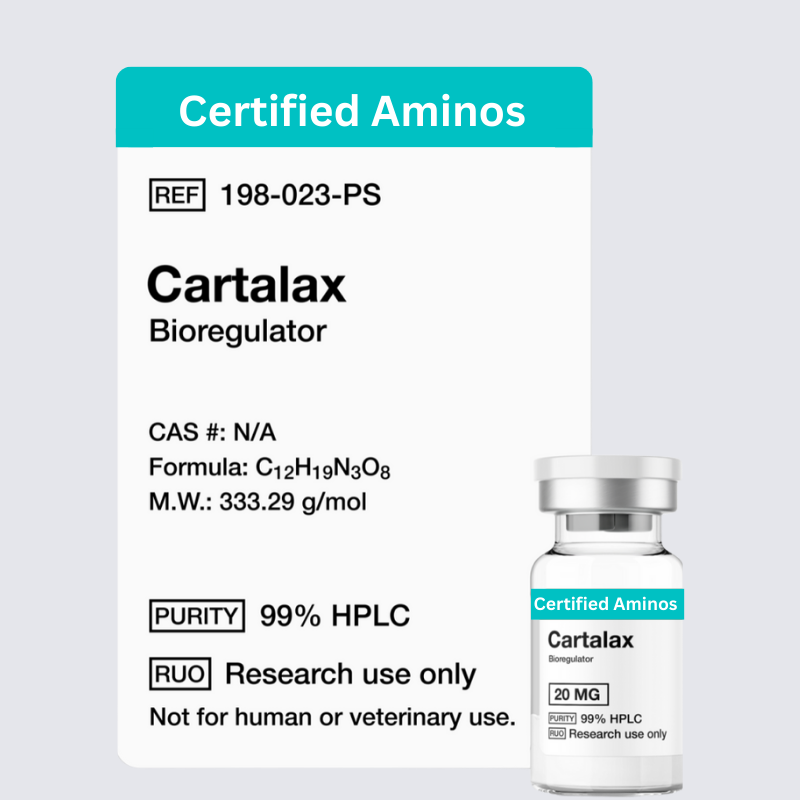
Cartalax 20mg (Bioregulator)
Support for Healthy Aging and Tissue Regeneration
Cartalax is a short bioregulatory peptide known for its powerful role in promoting cellular health, especially in tissues rich in fibroblasts—like the skin, cartilage, and kidneys. It’s been studied for its ability to boost cell regeneration, reduce cellular aging, and restore vitality to aging tissues. As a result, Cartalax is often considered a potent anti-aging support agent.
What is Cartalax?
Cartalax is a synthetic peptide made up of three amino acids: Ala-Glu-Asp (AED). This simple structure has a surprisingly wide-ranging impact thanks to its effect on fibroblasts—cells found throughout the body that are essential for producing collagen and maintaining connective tissue integrity.
By improving fibroblast function, Cartalax helps regulate important processes like cell proliferation, apoptosis (cell death), and inflammation—making it a valuable compound in age-related research.
How Cartalax Works
Cartalax influences several key cellular pathways:
-
Boosts Ki-67 levels, a marker of active cell growth
-
Reduces p53 activity, which is linked to aging and cell death
-
Activates NF-kB, involved in immune response and tissue repair
Together, these effects promote healthier, more active cells and contribute to slowing down the aging process at a cellular level.
Skin and Connective Tissue Benefits
Research has shown Cartalax can improve skin health by:
-
Enhancing skin cell renewal
-
Supporting collagen production
-
Reducing the breakdown of the extracellular matrix
-
Suppressing skin cell death
Its positive effects are particularly evident in aging skin, where it helps restore a more youthful look and function by supporting fibroblast performance.
Cartilage and Joint Support
While direct studies on Cartalax and cartilage are limited, its well-documented influence on fibroblasts suggests strong potential in supporting joint and cartilage health. Fibroblasts are central to maintaining cartilage homeostasis and play a crucial role in balancing the breakdown and rebuilding of tissue.
By regulating molecules like MMP-1, MMP-9, AP-1, and TGF-β, Cartalax helps maintain tissue structure and function. These balancing effects make it of interest for conditions such as arthritis, osteoporosis, and connective tissue degeneration.
Kidney Regeneration Potential
Initial studies on kidney tissues revealed that Cartalax, derived from polypeptide extracts, promotes kidney cell renewal. In lab studies, it has been shown to:
-
Increase cell proliferation
-
Decrease aging markers like p16, p21, and p53
-
Boost SIRT-6, a key player in preventing cellular aging
This regenerative effect holds promise for age-related kidney decline, although more research is needed.
Anti-Aging Effects on a Cellular Level
Cartalax is especially effective in aging cells. It helps reverse markers of cellular aging and restores function to older cells by modulating genes such as IGF-1, FOXO1, TERT, and NF-kB. These changes can be quite significant—sometimes up to 5.6 times the normal expression levels.
As a geroprotective agent, Cartalax supports long-term tissue vitality and healthy aging.
Technical Information
-
Peptide Sequence: Ala-Glu-Asp (AED)
-
Molecular Formula: C10H15NO8
-
Molecular Weight: 333.29 g/mol
-
Synonyms: T-31, AED, Alanyl-glutamyl-aspartic acid
-
PubChem CID: 87815447
Disclaimer
All information provided is for educational and informational purposes only. Cartalax is intended for in-vitro research use only and is not approved for human or animal consumption. This product has not been evaluated by the FDA and is not intended to diagnose, treat, cure, or prevent any disease.


Reviews
There are no reviews yet.