

Description
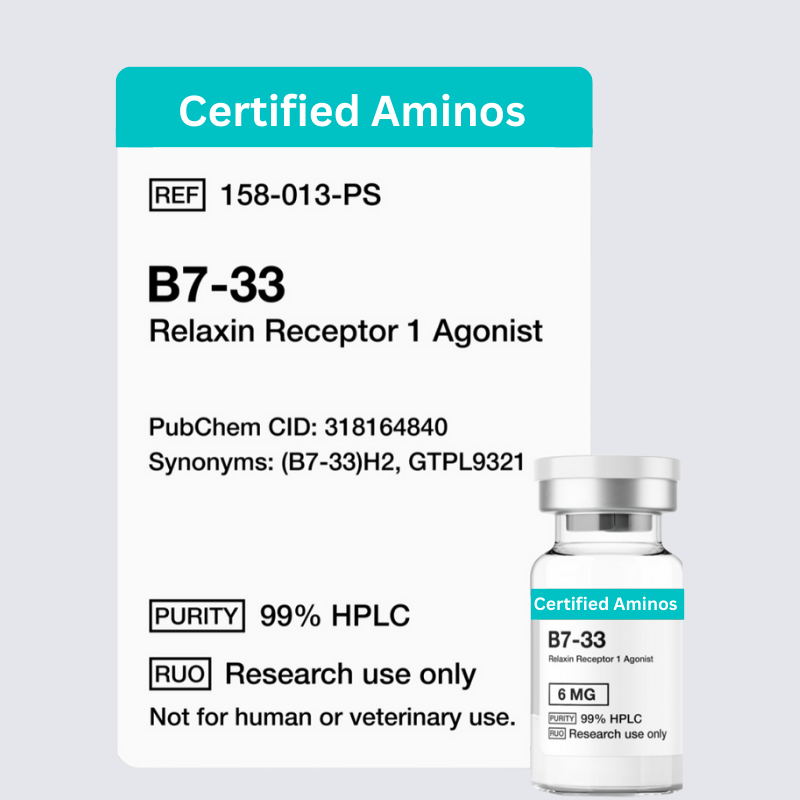
B7-33 6mg – Innovative Peptide with Potent Anti-Fibrotic Benefits
B7-33 is a next-generation synthetic peptide that’s attracting growing attention for its powerful anti-fibrotic effects. Currently under active research, this peptide has shown promising results in reducing scarring and tissue fibrosis across several conditions—especially heart failure, lung inflammation, and kidney damage.
In animal studies, B7-33 cut fibrosis by nearly 50%, improving survival after injury and opening the door to potential breakthroughs in chronic disease treatment.
What Is B7-33?
B7-33 is a lab-engineered single-chain peptide derived from the human hormone H2-relaxin. While it retains the core anti-fibrotic effects of its parent molecule, it’s designed to be safer and more selective. Unlike H2-relaxin, B7-33 does not trigger the cAMP pathway, which has been linked to side effects like increased heart rate and tumor growth.
Instead, B7-33 activates the ERK1/2 signaling pathway, which promotes the production of matrix metalloproteinase-2 (MMP-2)—an enzyme that helps break down excess collagen, reducing scar tissue formation.
How B7-33 Works
B7-33 works by selectively binding to the RXFP1 receptor, triggering a cascade of events that stop excessive scarring at its source. It activates the pERK pathway, which helps regulate cell growth and promote tissue repair—without the unwanted effects seen with full-sequence H2-relaxin.
This makes B7-33 a standout candidate for treating diseases that involve fibrosis, like:
-
Heart failure
-
Lung fibrosis
-
Kidney damage
-
Certain vascular conditions
-
Preeclampsia during pregnancy
Easier and More Affordable to Produce
One key advantage of B7-33 is its simplified structure. Its design makes it significantly easier and less expensive to manufacture compared to the full H2-relaxin protein, which is structurally complex and can only be delivered via IV.
Thanks to its streamlined structure, B7-33 is more accessible for research and potential future therapeutic use.
Anti-Fibrotic Potential in Research
Fibrosis (abnormal scar formation) is a leading cause of organ failure in chronic conditions. Research shows that B7-33 effectively reduces scar tissue, particularly in the heart following injury. In rat models, it lowered cardiac fibrosis and improved overall heart function.
Notably, even when tested in cancer models, B7-33 did not promote tumor growth—setting it apart from its parent molecule, H2-relaxin.
Vascular Protection and Blood Pressure Support
Beyond its anti-fibrotic actions, B7-33 mimics the vascular benefits of serelaxin (human relaxin-2), including blood vessel relaxation and improved endothelial function. In preclinical studies, it helped arteries respond better to signals like bradykinin, aiding in blood pressure regulation.
These vascular effects suggest that B7-33 may be useful in treating hypertension-related conditions and pregnancy complications like preeclampsia.
B7-33 and Preeclampsia
Preeclampsia is a serious pregnancy complication involving high blood pressure and poor fetal growth. In lab research, B7-33 was shown to boost the production of VEGF (vascular endothelial growth factor) in fetal cells—helping to improve blood flow between mother and baby.
Even better, lipidated forms of B7-33 showed a longer half-life in the body without losing their potency, potentially allowing easier administration and more sustained therapeutic effects.
Novel Use in Medical Implants
Another exciting application of B7-33 is in anti-fibrotic coatings for medical implants. Typically, the body tries to isolate foreign devices through fibrosis, which can limit their function or cause complications.
However, B7-33 coatings have been shown to reduce fibrotic capsule formation by up to 50% in animal studies. This could lead to safer, more effective implants—possibly eliminating the need for systemic drugs like blood thinners.
Summary
B7-33 6mg is a promising peptide with a unique profile:
-
Reduces fibrosis and promotes tissue healing
-
Safer and more selective than H2-relaxin
-
Supports vascular health and blood pressure control
-
Shows potential in managing preeclampsia and improving pregnancy outcomes
-
May enhance the longevity and performance of implanted medical devices
With its ease of production and wide range of applications, B7-33 stands out as a valuable research compound in the study of chronic diseases and advanced therapeutic technologies.



Reviews
There are no reviews yet.